'Buying NZ Property – Download the free sample readings!

NZ presents some of the most alluring property in the Western World; particularly given the greater easy of residency, the low cost of property, and the liveability of the country. In addition, there is no capital gains tax, transfer taxes, VAT/GST or wealth taxes in NZ, so rest assured that NZ property is tax-effective! Learn more now!

New Zealand Property Report 2010 - Download the table of contents or buy this 180-page report at our online store for just $US19.95.


Showing posts with label Maoris. Show all posts

Wednesday, February 8, 2012

NZ considering fees on national park entry

Share |
It appears NZ is going the path of Australia and introducing fees upon entry to national parks. There are a number of issues:
1. Fees for what? The problem with such fees is that there should be some service attached to the fee. They should not be for general revenue raising; not to fund wildlife studies, but for the improvement in services that park users want, i.e. Toilets, information centres, walking trails. I frankly think NZ has under-invested in walking trails. I have driven around NZ several times, and you seldom find a walking trail, they are always poorly marked, so you inevitably get lost, wondering whether the trail is the 4WD track. I got lost in Mt Cook glacial walk because what I thought was a side-track to a pond never actually rejoined the trail. Not lost in the sense of dangerously disorientated; but mislead. It should not have happened.
2. Fees for whom? The idea of only charging foreigners is ridiculous. NZ'ers use these facilities as well; charge NZ'ers and keep the fees lower.
3. Fees for extortion: I personally think NZ is already charging excessive fees in some areas, i.e. the fee charged at Rotorua's hot springs is unreasonably high; and I'm inclined to believe its extortion by the local Maori communities who tap into this revenue stream, and probably do no work to maintain it. i.e. Just relying on Pakehe contractors to do everything...and live it up on the cashflow. I have no idea; just suspicious, as this type of jibe is not new to the world. Its the same with Uluru in central Australia. They apparently 'own' Ayers Rock because they saw it first, turned in into a mystical symbol. We really have to stop granting property rights to people who see things first.

Clearly some national parks justify fees; others don't. The greater the attraction; the greater the prospect of having visitors and them being prepared to pay fees....but please, do anyway with the idea of extorting wealth from people; it just stops people from doing anything. I've still not been to Rotorua. I refuse to pay $130 for a family to see a natural phenomenon; knowing that there are bus loads of tourists. They are not spending millions on maintenance and salaries each week...they are doing it because they can.
You can argue that its Maori property (or public Crown land), but I would argue they did not see the value; they had no notion of property rights, and they certainly did not 'earn it', and don't deserve it merely by being empowered by liberals to extort wealth. They can't even find good use for the money.

Tuesday, February 7, 2012

The Maori Holocaust - a point of reflection

Share |
A NZ Maori academic has angered New Zealanders for comparing the colonialisation of NZ to the Maori holocaust in the wake of Waitangi Day. The question is whether the comparison is legitimate - or whether these comments were an effort to extract sympathy concessions from the colonisers.

In some respects you can say that the colonisation of NZ was analogous to the Jewish Holocaust. Consider that a very large proportion of the Maori population died with the introduction of European diseases; there were also battles with the army and skirmishes with settlers which were also going to take a toll on their population as they fought the European colonisers.

But there are some important differences as well. For instance,
1. The Maori did not develop their intellect sufficiently (largely because of their collectivist roots, lack of protracted struggle and small population) such that they confronted resilient, sophisticated enemies nor develop an enlightened theory of values, i.e. A framework for the development of personal rights. They would hence remain collectivist and some defiantly so.
2. The Maori had some element of empowerment in the sense that they were able to launch warfare themselves. The NZ Crown was responsible for Maoris, so as custodians they did tend to take steps to protect them, even if those efforts were under-resources, too little, too late, and subject to rationalisation.

I am inclined to say that there are no descendants able to complain about European colonisation; but this does not end the story. Maoris are today living in a certain context which was the result of NZ occupation. I would however be more worried about the context in which they are living today, not the injustices of centuries past. Why? Well, irrespective of whether they were treated well or not, in many respects they were treated better than the Pakeha (NZ colonialists). The reason is that NZ colonialists had to confront Maori attacks. They had greater resources at their disposal, but they had in some respects been subjected to the interests of the government more than the Maori. Maoris were eventually given land, and their grievances carry more weight today than 'British subjects' because there is some recognition of the plight of Maori....but there is no recognition that Pakeha are suffering; and that is because Westerners are more inclined to repress their subjugation. i.e. Pakeha are economic slaves to the government; forced to provide welfare support to Maoris; not because we like being slaves, but because we are forced to contribute to a form of government which does not solve the problem.
We might ask what was the nature of Pakeha subjugation to the British government; now subordinated to the NZ parliament. Well, its nature is that Pakeha are assumed to have certain rights as citizens; but this is 'conveniently' not a comprehensive or effective range of rights, such that they are actually slaves working for the sake of political middlemen; largely while many Maori live on benefits. We are not accustomed to treating benefits/welfare support as 'suffering' - more as 'support', but this is not entirely accurate because it is akin to child abuse to pander to Maori indulgence, and this is what the Pakeha have done to appease the political influence of modern-day Christian liberals as well as concrete-bound Maori who don't look beyond their short term expenses and consider their long-range self-esteem. There is no doubt that Maoris need support, but it has to be conditional upon certain objective standards. If its not; then the current issues of child poverty, high unemployment, high illiteracy and the current 'guilt industry' are destined to polarise NZ'ers into racial divisions.

Maoris are deserving of empathy; but Maori (in their sustained suffering as a result of poor Pakeha public policy) should not forget that Pakeha are deserving of empathy as well. This might not be easy when you are a sufferer, but its a prerequisite as a believer in justice. We have to rise above our concrete context, and think as intellectuals. Sadly, that message is lost upon both Pakeha and Maori. Its not about whose suffering was worse: its about how to expunge what still remains; a dissatisfaction with the current state of affairs. Let's not turn this into a race issue; but focus instead on the question of delivering our expectations to government. The consternation of Maori ought to be shared by Pakeha and vice versa. Their common enemy is the government which:
1. Denies everyone personal sovereignty - whether Maori or British 'subjects'
2. Specifically a lack of economic rights - the govt right to tax needs to be at the people's discretion otherwise there is no prospect of accountability
3. This discretion need not be a financial discretion - but plausibly an intellectual discretion
4. The basis of our political discourse needs to be rational - not majoritism or 'numbers' based extortion of political influence.

When Maori and Pakeha jointly grasp that possibility; only then will they realise that representative democracy is not serving them; and that only a meritocratic democracy will. A meritocratic democracy is not a aristocracy; its a forum for rational discourse. It is a forum which affirms the interests of the rational; whether they are one person or 1 million; whether they are NZ or foreign citizens. Any other framework is a basis for abuse. If the option existed in the 18th century, it might have prevented the settlement of NZ. Its hard to say; as ultimately this political system had to develop. But unlike the contemporary system, a meritocracy will advance people's thinking, and not result in the systematic 'dumbing down' of voters we see today. More is said on this issue of course in politics blog.

Monday, May 9, 2011

Threats made against Maori Party candidates

Share |
Reading the NZ Herald today it is apparent that the Maori Party and newly established Mana Party seem compelled to destroy each other, and in the process drive Maori votes towards the mainstream parties. We might expect the Labour Party to be the beneficiary of this bickering. No one wins in these types of slanging matches. The implication is that we will have further concentration of power in the major parties.
The other interpretation is that such blaster is part and parcel of Maori political discourse, and that at the end of the day, they will still vote Maori. I know few Maori people, having only lived in NZ for 2 years, but I suspect a good many of them consider themselves foremost human beings, and give secondary consideration to being Maori. So it will be interesting to see how they vote....or whether they vote at all. Does Honewira MP raise the voter participation with his new party, or does he earn their derision.
It remains to be seen.

Wednesday, May 4, 2011

Hone Harawira MP - ignorant or moral crusader

Share |
What are we to make of Hone Harawira's statements that Osama bin Laden was "a man who fought for the rights, the land and the freedom of his people".
The problem with these assertions is that they offer no clarity and are misleading. They show that the MP represents is ignorant, and assuming they know his values, that they share his ignorance. This is both a problem and an opportunity, because everyone is important to someone, and if we are respectful of the rights of people, then we should take an interest in what others think, and attempt to correct their assertions. This of course is more difficult if they lack a respect for facts. Here are the problems with what Hone Harawira's said:
1. Bin Laden did not advance the rights of Arabs; he exposed them to collectivist contempt, dangers of civil war.
2. Bin Laden did not convey an intellectual defence of rights, which are sadly lacking in the Middle East; instead deciding to attack a country which has one of the 'relatively' better track records. If his argument defence was that America was the better but offered a bad example, or was inconsistent, he did not make that 'intellectual argument'. He resorted to violence instead; misdirecting resentment in his own country.
3. Bin Laden might well have had some notion of rights, but it was not an objective or conceptual framework that entailed or required any intellectual discipline. His actions suggest his rights were won at the expense of others rights. Did the US model these values? Probably, as US foreign policy stinks as an educational tool. Listen to US politicians and you only get the sense that the US is out to advance its vested interests. We don't get any sense of intellectual or moral engagement; which is a problem in a crowded globe that requires respect and cooperation from others; particularly when 70% of global oil supplies comes from the region.

It is interesting that Harawira draws upon Maori culture, which I have little knowledge of, but which I would expect would be collectivist in nature. He said the al-Qaeda founder should be "honoured" rather than "damned" in death based on Maori values. It was Maori custom to acknowledge the dead. Other Maori politicians had a different perspective. These representatives clearly embody a higher degree of Western influence; leaving Harawira sitting out in the wilderness as a Maori nationalist.
Harawira said bin Laden had "pursued independence for his people, his family and his tribe". Unfortunately, his independent entailed destroying the lives of others. He needed to make an intellectual argument; but instead he resorted to violence.
He indicated it was Maori custom... "tributes to the dead are always appropriate"...that "it was custom for Maori to "honour and mourn the deceased".
This of course suggests unsurprisingly that Maori culture is based on moral relativism.
If there is any value in Harawira's statement it is in the acknowledgement that Bin Laden did embody some hope for Arabs in the Middle East, and he did change the nature of US engagement with the region.
The notion however that he advanced or "fought for the rights, the land and the freedom of his people" is a nonsense, because he showed no respect for rights...merely his countries interests at the expense of others. Sadly, the US did not help matters. They might well argue that its not in their narrowly defined interests to educate Arabs. They paid the price for their 'narrow' defined philosophy of pragmatism.
Maori Party co-leader Pita Sharples said 'utu' (revenge) was a Maori custom. "But we don't agree with the extent of the celebrations or with anyone celebrating the assassination of anyone and then the person's body being discarded into the sea."

Labour MP Shane Jones repudiates Harawira's view, arguing that: "In the old days, a great enemy - if he wasn't eaten - his bones were used to make musical instruments. So this romantic notion that in the old time, Maori spent hours of their time saluting the enemy was not the case".
This need not however be a repudiation, since Maori culture might differentiate the spirit from the body, and find some spiritual virtue in eating them.
His other argument however does repudiate his assertion; although, does all Maori beliefs have to be the same given the different tribes spread around the country. Jones argued "Enemies were turned to dust and people rejoiced, because of the suffering they had caused".

Source of quotes - "Bin Laden a freedom fighter - Harawira", NZ Herald, May 5, 2011

Sunday, February 20, 2011

Hone Harawira being smeared - NZ politics

Share |
This is going to be a protracted election year in NZ. Already we are witnessing the smear from elected representatives....is that what they are?
According to the NZ Herald, there is evidence suggesting that the rogue Maori Party MP Hone Harawira sought a ministerial position when it was negotiating a coalition with National Party. The implication is that Hone Harawira is disingenuous because he is now against the coalition. The implication is that because Hone Harawira did not get a ministerial position, he is now doing a dummy spit.
Of course this is the implication the Maori Party want you to draw, and its the one the National Party also want you to draw because they do not want you to vote for him in the next election, and to diminish the position of the Maori Party, or upset their cozy coalition.
The reality is that this is just one possibility. Maybe Hone Harawira did do a 'dummy spit', and resented not being given a ministerial position. The other possibility however not countenanced by this MPs all too willing to discount him, is that the Maori Party MPs have alienated themselves from their electorate by forming a coalition with a party which represents values remote from its own. The second plausible reason that Hone Harawira has changed his mind about the coalition is because:
1. He expected the coalition to achieve real concessions from the National Party
2. He actions of the party since the coalition was formed
3. The practical consequences of forming the coalition

I don't like the politics of the Maori Party any more than I like Hone Harawira. I think they are all corrupted by our system of government. Democracy, if you read my political blog is merely a process for legitimatising collectivism or tyranny. It is not a system of justice, as no system which does not respect objectivity can be. The political discourse I am highlighting here is just a swob from the wound caused by democracy. It is truly a flawed system, and these political power plays and extortive tactics are democracy, and are not merely a side-show.
So I say, don't vote for any of them. Vote for the most unlikely of candidates - an unaffiliated libertarian. Not because you embrace their politics or philosophy, but because they embrace small government, which means they want to diminish the side-show. That is the least you could do. The most that you could do is to get off your butt and protest the fact that democracy is a repudiation of economic rights, which means you have no rights at all. Political rights without economic rights is a myth. It is not 'No taxation without representation', its 'Representation is a myth, taxation is slavery'.
Don't be lured into these false dichotomies, as if it was one or the other. You don't have to mortgage your personal liberty to attain freedom. You just have to recognise your sovereign right to be free from the coercion of others. i.e. The problem today is that coercion is practical. It is practical because the majority sanction it. You would not allow others to abuse your children; acknowledge that you are allowing your government to abuse you, but failing to acknowledging the abuse - unconditional taxation/expropriation. That is tyranny - you have no recourse. Don't pretend for a moment that a vote every 3-4 years makes a difference when the vote offers no political point of differentiation, when the two parties are the same, and there are only two parties. Its an illusion; all smoke and mirrors. You have been had.

Sunday, September 19, 2010

Persistent Maori land right issues in NZ

Share |
The British Empire was a collectivists regime which displayed the same contempt for individual rights that we might associate with China, or sadly the modern state. Individuals were not called 'subjects' for no reason. Personal interests were subjugated to the collective interests. In the case of NZ, Maori land rights were not honoured; lands were seized. Some tracts of lands were given back in certain circumstances, but others missed out. The process for seizing lands was pragmatic; the process for compensation is arbitrary and as unfair as the process for seizing the land originally.
NZ really does need to step up and recognise the rights of Maori to those lands which are not privately owned. No one needs to gain at others expense. I must say however that 'occupation' is a rather loose concept of ownership. There is no reason for a group to be placed in a position to extort value from others for lands which they scarcely use, because they were there first. The notion of 'first occupant' sets the rules does not recognise the common nature and needs of humanity, and does not respect the healthy basis upon which relationships between people ought to be defined.
The problem however is that the existing legislation for dealing with Maori land right claims is inherently flawed. See this NZ Herald article for more information.

Tuesday, September 14, 2010

Maoris to lose rights to seabed and more...

Share |
NZ Maoris are fighting to retain their rights to the seabed. You might have thought this silly. How possibly could the Maoris have the rights to the seabed. Well, I agree. There is no practical way that Maoris could have rights which would deny access for white NZ'ers. The problem however is that there are greater issues involved, and the Maori Party is quickly digging itself into a hole, where they will be slaves (like British 'subjects') to the govt. In fact they are already appeasing government, but very soon they will be surrendering their moral agency or legitimacy to a court system which will not interpret the law in their favour.
The National Party wants them to cede control of the sebed in exchange for the opportunity to negotiate individual claims on a case by case basis. The Maoris after decades of failed negotiations are desperate for a win. Its showing, because they are about to be sold a lemon. The govt realises that if they can sell this agreement to Maori, they would have side-stepped the implications. Why? There are several strategic advantages for the govt:
1. They will not have to deal with the issue
2. The courts will decide the outcomes
3. People will not know the merits of specific cases, so any public sympathy will be muted.

This is a dangerous agreement for Maori, but also for all NZ'ers. Why? The best prospect that white NZ'ers have for getting rights is if Maoris are recognised as having them. After all, if a minority are recognised as having rights, pretty soon NZ whites will want them as well.

The Maori Party is self-serving, like all politicians. Their credibility they think rests on getting an agreement. the reality is that they will win a battle, but cede the war. That is bad for everyone. So what can we expect from this agreement. Well, Maoris will retain certain allocation rights for fishing, but they will lose control of important mineral districts like the titanomagnetite beach sands stretching from Wanganui to Huntley, on the North Island.

Maori Party MP Te Ururoa Flavell said the bill was the best the party could negotiate in the circumstances and it was possible there would be "another time for our people to come back and have another go in the future".
There is no chance in hell of that happening. This is a sell-out. The best chance Maoris have is through the courts. They ought not be seeking a parliamentary outcome. The party is happy to repeal the Foreshore and Seabed Act 2004 and restoring the right for iwi to go to court to seek customary title through the courts or in negotiations with the Government. They have six years to make any claims. Good luck with that.
Maori Party MP Hone Harawira is the only one objecting to aspects of the new regime. The problem is that he is opposing issues he cannot reasonably expect. There needs to be a single objective act governing all people. They ought to be fighting for common rights, not Maori ownership. What is the difference - Maori tyranny is just as worrying as a govt one.

The Labour Party is playing the same game of course, arguing that "the party does not wish to play politics on the matter". Surprisingly it is the Green Party woh are opposing it. Co-leader Metiria Turei said "it did not address the fundamental injustice of Maori losing ownership rights". Who would have thought that a collectivist organisation like the Greens would be advocating rights. Well, of course its not an objective concept of rights, its the subjective type which enslaves. It just so happens on this occasion, they are supporting Maori because they have a legitimate gripe with the govt. Rest assured they will be throwing wealthy people under a bus on another day for some poverty stricken soul, neglecting human nature in the process....appealing to some court term emotive need, rather than policies which actually fix problems.
------------------------------------

Thursday, September 3, 2009

Maoris taking the wrong approach to self-empowerment

Share |
Over the last few months the town of Wanganui has been wrangling with the issue of whether the council should change the name of the town to 'Whanganui', in accordance with the traditional Maori spelling. If changing the name was such an easy thing to do, we would of course conclude 'Why not'? The reality however is that a name change causes a great deal of inconvenience and cost to people because it requires:
1. Changing business names, changing address details, changing signs
2. Changing brochures, letterheads

My estimate is that it would cost $50 million to change these issues immediately, but far less if the change was graduated over 10-20 years since signs get revised, advertising gets re-written over time. After 10 years the cost might be as little as $2 million in terms of direct costs. But there is another problem.....confusion. People in NZ will of course be able to follow the issue, but for foreigners its a change that can only cause confusion. Maoris seem to have no regard for the impact of these superficial changes.

Is this the foundation of Maori pride? To have their rights neglected while they secure superficial name changes. The historical legacy of British occupation of the NZ islands was one of disrespect and ill-regard for Maoris. They have the basis upon which to demand significant concessions from their European custodians. But the best they can do is superficial name changes? Is this a strategy to weaken the enemy?

My belief is that if the Maoris continue to press cases for silly concessions like name changes, then they will surely only alienate empathy from Europeans who think they were ill-treated by the British. What is more concerning is that the Maori pursuit for recognition of rights could actually be a basis for wider recognition of rights for all NZ'ers. The problem as I see it is that people think the Bill of Rights actually gave them rights. This is more evidence of superficial thinking - this time by the Europeans. A Bill of Rights does not protect rights - it sabotages the possibility of having them. Have you read the book '1984'. Do you recall the concept of 'DoubleSpeak'. You have rights in name only. A right does not comprise a claim upon others rights. A right is not arbitrarily defined. A right is not a parliamentary sanction. A right is not a concession by a pack of politicians. When it is - you should be very very suspicious.

The way forward for Maoris is not arbitrary name changes - it is High Court challenges in the hope that they will eventually secure concessions as a result of judicial activism. Of course they will need an ethical argument to have success by this path. Personally I see little sign of long range thinking or the intellect to achieve such an outcome for all 'freedom-loving' people. For this reason I would suggest we will remain in a servile relationship with the state. Dutifully paying taxes with no choice, and no possibilities of standards of accountability, or any effective reproach. They have shored up the system so they have a two-party duopoly. Where is the justice?

'Buying NZ Property – Download the free sample readings!

NZ presents some of the most alluring property in the Western World; particularly given the greater easy of residency, the low cost of property, and the liveability of the country. In addition, there is no capital gains tax, transfer taxes, VAT/GST or wealth taxes in NZ, so rest assured that NZ property is tax-effective! Learn more now!

New Zealand Property Report 2010 - Download the table of contents or buy this 180-page report at our online store for just $US19.95.


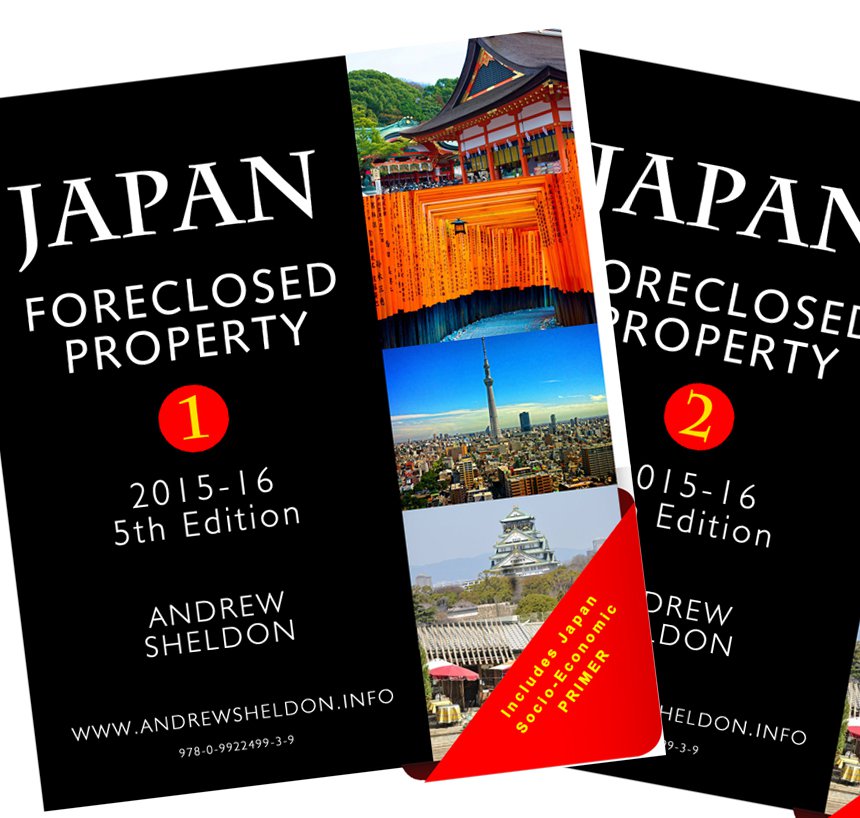
Japan Foreclosed Property 2015-2016 - Buy this 5th edition report!

Over the years, this ebook has been enhanced with additional research to offer a comprehensive appraisal of the Japanese foreclosed property market, as well as offering economic and industry analysis. The author travels to Japan regularly to keep abreast of the local market conditions, and has purchased several foreclosed properties, as well as bidding on others. Japan is one of the few markets offering high-yielding property investment opportunities. Contrary to the 'rural depopulation' scepticism, the urban centres are growing, and they have always been a magnet for expatriates in Asia. Japan is a place where expats, investors (big or small) can make highly profitable real estate investments. Japan is a large market, with a plethora of cheap properties up for tender by the courts. Few other Western nations offer such cheap property so close to major infrastructure. Japan is unique in this respect, and it offers such a different life experience, which also makes it special. There is a plethora of property is depopulating rural areas, however there are fortnightly tenders offering plenty of property in Japan's cities as well. I bought a dormitory 1hr from Tokyo for just $US30,000.
You can view foreclosed properties listed for as little as $US10,000 in Japan thanks to depopulation and a culture that is geared towards working for the state. I bought foreclosed properties in Japan and now I reveal all in our expanded 350+page report. The information you need to know, strategies to apply, where to get help, and the tools to use. We even help you avoid the tsunami and nuclear risks since I was a geologist/mining finance analyst in a past life. Check out the "feedback" in our blog for stories of success by customers of our previous reports.

Download Table of Contents here.