'Buying NZ Property – Download the free sample readings!
NZ presents some of the most alluring property in the Western World; particularly given the greater easy of residency, the low cost of property, and the liveability of the country. In addition, there is no capital gains tax, transfer taxes, VAT/GST or wealth taxes in NZ, so rest assured that NZ property is tax-effective! Learn more now!
New Zealand Property Report 2010 - Download the table of contents or buy this 180-page report at our online store for just $US19.95. Monday, April 2, 2012
Japan property cheapest in the world
Thursday, May 19, 2011
Buying property in NZ - the short and long term
Wednesday, January 19, 2011
NZ does offer attractive buying
Tuesday, January 18, 2011
The outlook for the NZD
Thursday, December 3, 2009
The cost of building in NZ
"I have been amazed at the prices to build. They are about twice what I could build the same house for in the US. This is hard to understand since many of the materials are (lumber, stone) are from NZ and the labor rate is cheaper. We own the land so it is just construction cost. The house would be considered upper middle class nice in the US but nothing really special. The builders in NZ seem to be somewhat confounded".I agree. Not sure why this person built a new house as that is the most expensive approach. There is plenty of housing stock around, and with interest rates about to go up because of inflation, I hope you have a low debt. It is expensive to build I think for five reasons:
1. Huge mark-ups on materials - did you buy the materials online? Should have got a list of materials from the architect.
2. Labour rate can be cheap - unless you use one of these national franchises. A lot of local labourers head to Australia for higher rates, so can be tight in areas.
3. Not all materials are made in NZ. A lot of things are imported. i.e. the high cost components.
4. There is a lack of competition compared to the USA
5. There are a lot of building regulations which effectively lock out handymen, who might otherwise provide some competition
It is so much cheaper to just buy an old house and renovate. Hamilton is a bit of a growth area, so maybe you had no choice. Anyone seeking to buy a house should rent for 1-2 years until inflation starts to hurt existing home owners. There are houses for sale in some areas which will only cost you $0-30,000 over land prices. Building the equivalent sized modern home would cost you $120,0000 and yet the old home is made out of quality hardwood which wood last another 100 years if well cared for.
If your a voter - that's the price you pay for supporting governments who embrace easy monetary policies that spark asset inflation.
Wednesday, September 30, 2009
Property prices in NZ

Do you want to know the cheapest and most expensive houses in NZ?
Well its $7500 for the cheapest and $12.1 million for the most expensive - that's NZD of course, so multiple by 0.71 for the USD amounts. See the details at the NZ Herald. Unless you are buying at the lower end of the market its not time to be buying yet. Wait for global inflation to start hurting people.
Wednesday, September 9, 2009
Property prices rising in NZ
1. The return of NZ expats from abroad - this will have increased home demand
2. The monetary stimulus - which essentially recapitalised the global monetary system, which keeps inflating asset prices
3. A fall in the NZD over the last year, resulting in very good market entries for foreign buyers
4. Latent demand - there is a shortage of property in many of the largest cities
For statistical info refer to this SMH story. The market can be expected to remain strong in the short to medium term, though inflation poses a risk to houseowners given the significant household debt levels. A conservative home equity is advised in the current market. Equities are far more liquid.
*Photo is from taken from city center, New Plymouth, New Zealand.
Monday, August 17, 2009
NZ taxation under scrutiny
1. It will fail to consider efficiency measures - it will focus on raising money rather than improving efficiency/productivity or cutting expenditure. e.g. From hospitals
2. It will fail to recognise where the prospects for economic growth come from. It will focus on cutting the corporate tax rates in order to attract large companies. The scope for expanding business in NZ does not rest on big business, it rests on small business. The reason I say this is because NZ is a very small market, and any decision to align with Australia is only going to reinforce the belief that any regional office in Australia (Syd/Melb/Bris) can service the NZ market. For most countries, NZ does not even justify a presence. This could actually be a strategic advantage for NZ small business.
There are likely to be two serious contenders for tax increases:
1. Capital gains tax on investment property - this would be consistent with the tax regime in Australia, and there is considerable appeal in aligning the tax systems.
2. Stamp duty on property transactions - expect a tax of up to 3%
3. An increase in the GST - I don't expect this tax increase to succeed, least of all at at time of recession. Frankly the suggestion that it is a serious prospect I believe is intended to make people feel like they actual 'won' a concession, when in fact the government will look at the other taxation options.
These tax increases will be used to fund tax reductions for business. The question is - do these tax cuts make sense? Given my arguments above, I believe any revenue increases should be used to invest in NZ small business rather than big business who really only invest in primary resources. Resource producers stand the best chance of passing through costs in this recession, so they are not the group of investors I would be looking to support.
Some time ago NZ joined the chorus of governments which adopted libertarian policies. I consider myself libertarian, but one has to maintain a sense of reality. It I was a taxpayer with any voting power I would not sell an asset based on prices of $0.12/kWh, only to allow the new owner to raise prices to the marginal cost required to commission new generating capacity, which is $0.24/kWh. The reason is because the power companies can generate ample profits at $0.12/kWh, given the cost of generation capacity is zero for most hydro plant (which is 70% of total capacity). Privatisation was a bad deal for NZ'ers. That does not mean it always is; just in this case. This is hardly an incentive for business investment. Of course big business can negotiate harder by 'threatening' to build their own generating capacity.
Another case of bad policy was the decision by the NZ government some years ago NOT to support 'winners'. I understand the sentiments of not providing subsidies to business, but there other choices. Small business in most countries have difficulty raising capital. Its even harder in small markets like NZ. This country needs strategic industries. Students need an assurance of jobs if they are going to study such subjects. This country needs to support niche industries, whether its manufacturing of niche sporting equipment, whether its subsidising a cargo vessels to make regular low-cost shipments to certain markets, whether its a trade shared vision for trade. I see that 10 wine growers in Australia are gathering to promote their wines. NZ needs the same shared vision. The challenges are:
1. Ensuring accountability so the money is not wasted
2. Ensuring that its not a tax scheme but an investment scheme because I hate the idea of trampling on people's rights.
It is all to often forgotten that taxation is a breach of the taxpayers rights to determine their own destiny. I can understand the counter-argument that there needs to be shared expenses like road funding, say with a road petrol tax, rather than tolls everywhere. Such taxes should be user pays as much as possible, and I think people should be able to sue the government for relief from such taxes. People should not not funding schemes they have no benefit from. We don't want bad schemes funded. There needs to be a pay-off. We need schemes to have objective standards of value, so that people and judges can establish their value. This is the vision of this report.
I am reminded of the book 'Bad Samaritans' by Ha-Joon Chang. It looks at history and discovers that the industrial giants, whether Britain in the 17th century, the USA in the 19th century, Germany and Japan in the 20th century, all existed as a result of protectionism. Only when these industries had established themselves did the governments wind back the subsidies. This is not to suggest the model of these countries is desirable. In fact there are many better ideas to boost investment. One option might be a family-based subsidy for business. It needs more thought by myself.
I think there are many successful business people in the world who succeeded because of help from family and friends. The reason that some form of incentive is needed is because people have a tragic sense of live. They are inclined to be cynical about others, and thus people end up with no savings, no customers, no feedback and no service. Ultimately a more prosperous economy today tends to arise only because of government stimulus, though such stimulus arises for the wrong reasons, in order to maintain demand, to keep governments elected; even if it hurts the economy.
Upon completion of this book I will demonstrate a scheme which will provide for the most efficient use of funds. Give me time...so many other books to write. :)

Tuesday, June 30, 2009
Do NZ property inventories indicate anything?
Insofar as market timing is concerned I believe buyers will have another opportunity to enter the NZ property market. I would also suggest that city properties have further to fall. I would not be buying city property at this time. My advise is to buy under-loved rural property if you must, as we did. We bought a lovely Victorian home in a small 40,000 town reasonably close to Wellington for $NZ78,000 ($US40,000). Since then the exchange rate has recovered and we believe the property has found a floor in this segment.
The next opportunity will come with city property, but not until people are squeezed by higher inflation. The property market is highly leveraged, and NZ is worse than most countries in this respect, which means great opportunities. Such issues are discussed in our Buying NZ Property report.
I don't want people to read too much into these inventory numbers because people are only going to sell at the top if they think the market has a lot more to fall. Buyers in rural areas will have recognised a bottom and pulled their property from the market. Buyers in the city will mostly be thinking their home is a long term investment, that it no longer makes sense to sell. That does not mean prices will not fall more. It just means people cannot see the inflationary outlook. Clearly that is going to impact on employment, interest rates, and the average over-leveraged home owners capacity to pay off their mortgage.
Tuesday, April 28, 2009
Foreign Income Tax Exemption for new residents
New immigrants to New Zealand qualify for the automatic tax exemption on their individual overseas income under the Taxation Act 2006. The tax exemption is targeted to encourage prospective migrants to consider New Zealand as a viable and competitive place to live and work. The exemption also applies to returning New Zealanders who have not been resident for tax purposes for at least 10 years before their arrival.
It operates to exempt all “transitional residents” from New Zealand tax on their foreign-sourced income by treating it as being derived by a non-resident. A person will be deemed a transitional resident if on or after April 1, 2006:
1. They have a permanent abode in New Zealand, and
2. Immediately before acquiring that permanent abode, they were continuously non-resident for at least 10 years, and
3. They have not previously been a transitional resident.
It is possible for a person who has visited New Zealand before acquiring a permanent abode – for example, to attend interviews or to look for housing – and who would otherwise be deemed resident in New Zealand (because they had been in the country for more than a total of 183 days in any 12-month period) to benefit from the exemption.
The transitional resident status will last for four years, ending on the last day of the 48th month after the month in which the person acquired a permanent abode in New Zealand; or the day the person ceases to reside in New Zealand. After expiry of this period, the person is treated as a resident, and their foreign-sourced income becomes liable to income tax in New Zealand.
The only types of foreign income not tax exempt in New Zealand are those derived from overseas employment performed while receiving the exemption, and business income relating to services performed offshore. All other foreign-sourced amounts (including interest, dividends, and employment and bonus income from previous employment) derived by the transitional resident are exempt.
The new legislation also provides that, where a settlor of a foreign trust becomes a transitional resident in New Zealand, they or any beneficiary or trustee of the trust will now have up to five years to elect for the foreign trust to become a qualifying trust. A foreign trust means that no settlor is resident in New Zealand from when the trust is settled until a distribution is made. A foreign trust is not required to pay New Zealand tax on its foreign-sourced income. If the election is not made, the foreign trust becomes a non-qualifying trust, with distributions of accumulated income or capital derived taxed at a penal rate of 45 percent. Previously, if a settlor of a foreign trust became resident in New Zealand, any of the settlor, trustee or beneficiary had only one year to elect to convert the foreign trust into a qualifying trust.
GST on New Zealand property
GST on NZ property depends on the nature of the property acquisition. GST is an indirect tax, and as such it is treated separately from income taxes, and its imposition is contingent upon the purpose of the property acquisition. There are 4 types of property buyer:
1. Home buyer - buying for residence or occupancy, say home or holiday house. Under the GST Act an home investor is exempt from GST, and need not register for GST, in fact they can ignore it, but they will nevertheless have to pay GST on costs associated with their purchase, e.g. Conveyancing.
2. Property trader - flipping property for capital gain. Property traders will confront GST upon sale of the property unless they can demonstrate that they did not intend to buy it for re-sale. If the property is purchased for on-sale, the buyer can claim back the GST. Refer to the 2nd hand goods provisions. of the Act Refer to the Inland Revenue website for more info.
3. Property investor - holding property for a yield investment return. A further distinction is made here between residential and commercial property investors. There is no GST on residential property, but there is on commercial property.
a. Residential property investors: The investor can claim GST as a management expense, thus as a deduction on their income tax return. With commercial property, GST is payable if the gross annual rental income exceeds $40,000. If the income is less than $40K, then GST registration is optional. You will need to decide upon two methods of payment, whether you use the payment method or invoice method. The payments method, which applies to actual transactions in the period, is the most common method for commercial investors.
b. Commercial property investors: If you are a commercial investor there is another concept - zero rating - that is important to understand, however this is beyond the scope of this blog. Ivestors in serviced apartments need to take particular care.
4. Property developers need to pay GST at the time of settlement, which is deemed to be at the point of settlement. If the developer's turnover exceeds $1.3mil, they must apply the invoice method. Developers expecting to claim a GST deduction need to demonstrate an ongoing pattern of property development. An adjustment is made for developers who cannot sell the property, which allows them to pay GST on the rented portion of the property (refer to (section 21 of the Act) or any portion occupied by them.
The distinction between being a property investor and trader depends on your motives for buying the property. A trader seeks profit, and pays income tax on it. An investor seeks rental yield and pays tax on it at the marginal tax rate. There is no capital gains tax as an investor because any gain is considered incidental or unexpected. A trader however expects to make a gain, so they will pay capital gains tax on that profit. Traders can refer to sections CB5 and CB21 of the Income Tax Act. The onus of proof is on the buyer (not the tax office) to prove their intent for purchasing a property.
1. ‘Buying NZ property’ by Andrew Sheldon – buy here for residential investors
2. 'Property Tax - A NZ investor's guide' by Mark Withers – buy here.
Tuesday, March 24, 2009
Australia & NZ are nice synergy
Monday, March 2, 2009
Weak NZD a boon for emigrants
1. Food products
2. Forestry
But it also means NZ has a strong point in terms of software programming and web design. There are a great many services you can outsoource to Asia, but as regardless of where you look, you will pay for skills. Traditionally we would not expect a backwater like NZ to offer competitive skills. In fact the low average wages in NZ tends to drive skilled labour out. This is why in previous years we have seen people moving out of NZ as retirees moved in.
In certain areas like software programming, where businesses are not requiring daily contact with clients, and can readily deal with client issues over the internet, the reasons for basing a business in NZ are compelling. NZ in this context becomes one of the cheapest places to set up a business. My partner runs a business LVG Consulting which can perform low-end search engine optimisation in the Philippines, but by partnering with local skilled video design editors, she is also able to project manage an array of online product marketing services with greater skills that would cost far more in the larger markets. She operates this business from a rural town in NZ because the town offers all the support we need, and offers a very attractive environment to live and to raise kids. The town is full of vacant office space if you retire a shop front, and buying such property at the current low exchange rate makes a lot of sense. There is even a local college which offers a source of recruits. The college is even attracting graphic design students from Asia. It is remarkable just how international NZ has become in the two decades. The shift started when Asians saw the country as cheap place to learn English.
The big news is that Australia, NZ and the ASEAN group of nations have negotiated a free trade agreement. On top of an already weak NZD, access to Asian markets can be considered a very attract development. You can expect a lot of investment in NZ to flow from this decision. NZ productive land land over a certain size is out of bounds, but there is still possibilities for Asians to engage in food production in NZ to supply their markets. There is of course the opportunity for Chinese, Malay, Singaporean, Filipino millionaires to buy holiday houses in NZ as well - given the possible trade implications. NZ has traditionally been a expensive place to travel, but that is changing. The opening up of Trans-Tasman flight routes has recently seen the price of NZ to East Coast Australian flights plummet. Expect more of this as the NZ Prime Minister seeks further integration of the NZ-Australian markets. There will be flow-on effects for NZ. NZ of course makes a lot of sense for tourists because of its cheap currency and world-class landscapes. Cheaper access through Australia should also make a lot of difference.
If you are interested in buying property in NZ - we recommend our NZ Property report. The amazing aspect about NZ is that its just not for millionaires. You can buy a house here for as little as $US35,000. You can get more value in NZ than in the Philippines. The best value remains in Japan. Of course people like the Philippines for other reasons.
Thursday, February 5, 2009
Attraction of NZ property for foreign investors
For foreign investors and NZ exporters things could not look better. OK, its true that the marketability of food will get harder during a global recession, but one must remember that NZ has a currency advantage, even over Australian produce, where NZ brands are already well-established. For foreign investors, particularly the British who have enjoyed holidays in NZ, they will be well-aware of the currency advantages investing in NZ. They have been here for years. There are already a great many English living in NZ. In the last 10 years the number of Asian immigrants from Korea, China, Thailand, Malaysia, the Philippines and other countries has greatly increased the population diversity, even outside the major cities. Many large towns have Chinese, Thai, Indian and Turkish restaurants.
The timing for investing in city property is premature since these prices are still falling. I however I recommend investors buy a rural-based property to establish a base in the country. Some rural property is offering excellent yields and the very low NZD offers a superb opportunity to lock in a very attractive cross rate, as well as giving you the opportunity to mortgage your local home to purchase more property. Depending on whether you intend to live here, repay the loan from offshore income (which makes excellent sense), the benefits are readily apparent.
There are also compelling financial benefits for property investors, including ZERO capital gains tax, stamp duty, GST and transfer taxes. None on property! This will suit medium to long term investors depending on their investment objectives.
'Buying NZ Property – Download the free sample readings!
NZ presents some of the most alluring property in the Western World; particularly given the greater easy of residency, the low cost of property, and the liveability of the country. In addition, there is no capital gains tax, transfer taxes, VAT/GST or wealth taxes in NZ, so rest assured that NZ property is tax-effective! Learn more now!
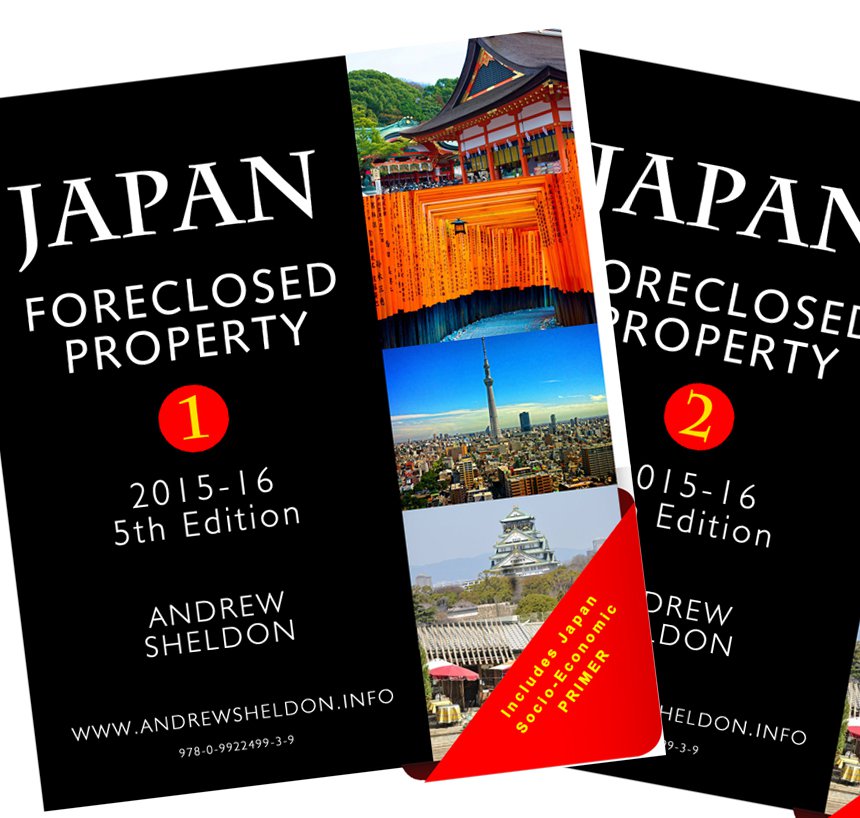
New Zealand Property Report 2010 - Download the table of contents or buy this 180-page report at our online store for just $US19.95. Japan Foreclosed Property 2015-2016 - Buy this 5th edition report!
You can view foreclosed properties listed for as little as $US10,000 in Japan thanks to depopulation and a culture that is geared towards working for the state. I bought foreclosed properties in Japan and now I reveal all in our expanded 350+page report. The information you need to know, strategies to apply, where to get help, and the tools to use. We even help you avoid the tsunami and nuclear risks since I was a geologist/mining finance analyst in a past life. Check out the "feedback" in our blog for stories of success by customers of our previous reports.
Download Table of Contents here.