'Buying NZ Property – Download the free sample readings!

NZ presents some of the most alluring property in the Western World; particularly given the greater easy of residency, the low cost of property, and the liveability of the country. In addition, there is no capital gains tax, transfer taxes, VAT/GST or wealth taxes in NZ, so rest assured that NZ property is tax-effective! Learn more now!

New Zealand Property Report 2010 - Download the table of contents or buy this 180-page report at our online store for just $US19.95.


Tuesday, April 28, 2009

Foreign Income Tax Exemption for new residents

Share |
In 2006 the NZ government made changes to the New Zealand’s income tax code which make immigrating or resettling in NZ particularly attractive for foreigners. New residents will be able to have an exemption on all foreign earnings for four years. This does not strike me as a particularly sensible law because the recession will last 4 years, so people might be prone to just leave the country in 4 years. But hell - who doesn't love a tax break!

New immigrants to New Zealand qualify for the automatic tax exemption on their individual overseas income under the Taxation Act 2006. The tax exemption is targeted to encourage prospective migrants to consider New Zealand as a viable and competitive place to live and work. The exemption also applies to returning New Zealanders who have not been resident for tax purposes for at least 10 years before their arrival.

It operates to exempt all “transitional residents” from New Zealand tax on their foreign-sourced income by treating it as being derived by a non-resident. A person will be deemed a transitional resident if on or after April 1, 2006:
1. They have a permanent abode in New Zealand, and
2. Immediately before acquiring that permanent abode, they were continuously non-resident for at least 10 years, and
3. They have not previously been a transitional resident.

It is possible for a person who has visited New Zealand before acquiring a permanent abode – for example, to attend interviews or to look for housing – and who would otherwise be deemed resident in New Zealand (because they had been in the country for more than a total of 183 days in any 12-month period) to benefit from the exemption.

The transitional resident status will last for four years, ending on the last day of the 48th month after the month in which the person acquired a permanent abode in New Zealand; or the day the person ceases to reside in New Zealand. After expiry of this period, the person is treated as a resident, and their foreign-sourced income becomes liable to income tax in New Zealand.

The only types of foreign income not tax exempt in New Zealand are those derived from overseas employment performed while receiving the exemption, and business income relating to services performed offshore. All other foreign-sourced amounts (including interest, dividends, and employment and bonus income from previous employment) derived by the transitional resident are exempt.

The new legislation also provides that, where a settlor of a foreign trust becomes a transitional resident in New Zealand, they or any beneficiary or trustee of the trust will now have up to five years to elect for the foreign trust to become a qualifying trust. A foreign trust means that no settlor is resident in New Zealand from when the trust is settled until a distribution is made. A foreign trust is not required to pay New Zealand tax on its foreign-sourced income. If the election is not made, the foreign trust becomes a non-qualifying trust, with distributions of accumulated income or capital derived taxed at a penal rate of 45 percent. Previously, if a settlor of a foreign trust became resident in New Zealand, any of the settlor, trustee or beneficiary had only one year to elect to convert the foreign trust into a qualifying trust.

GST on New Zealand property

Share |

GST on NZ property depends on the nature of the property acquisition. GST is an indirect tax, and as such it is treated separately from income taxes, and its imposition is contingent upon the purpose of the property acquisition. There are 4 types of property buyer:

1. Home buyer - buying for residence or occupancy, say home or holiday house. Under the GST Act an home investor is exempt from GST, and need not register for GST, in fact they can ignore it, but they will nevertheless have to pay GST on costs associated with their purchase, e.g. Conveyancing.

2. Property trader - flipping property for capital gain. Property traders will confront GST upon sale of the property unless they can demonstrate that they did not intend to buy it for re-sale. If the property is purchased for on-sale, the buyer can claim back the GST. Refer to the 2nd hand goods provisions. of the Act Refer to the Inland Revenue website for more info.

3. Property investor - holding property for a yield investment return. A further distinction is made here between residential and commercial property investors. There is no GST on residential property, but there is on commercial property.

a. Residential property investors: The investor can claim GST as a management expense, thus as a deduction on their income tax return. With commercial property, GST is payable if the gross annual rental income exceeds $40,000. If the income is less than $40K, then GST registration is optional. You will need to decide upon two methods of payment, whether you use the payment method or invoice method. The payments method, which applies to actual transactions in the period, is the most common method for commercial investors.

b. Commercial property investors: If you are a commercial investor there is another concept - zero rating - that is important to understand, however this is beyond the scope of this blog. Ivestors in serviced apartments need to take particular care.

4. Property developers need to pay GST at the time of settlement, which is deemed to be at the point of settlement. If the developer's turnover exceeds $1.3mil, they must apply the invoice method. Developers expecting to claim a GST deduction need to demonstrate an ongoing pattern of property development. An adjustment is made for developers who cannot sell the property, which allows them to pay GST on the rented portion of the property (refer to (section 21 of the Act) or any portion occupied by them.

The distinction between being a property investor and trader depends on your motives for buying the property. A trader seeks profit, and pays income tax on it. An investor seeks rental yield and pays tax on it at the marginal tax rate. There is no capital gains tax as an investor because any gain is considered incidental or unexpected. A trader however expects to make a gain, so they will pay capital gains tax on that profit. Traders can refer to sections CB5 and CB21 of the Income Tax Act. The onus of proof is on the buyer (not the tax office) to prove their intent for purchasing a property. If you require more information on property tax or buying NZ property, I refer you to the following books:

1. ‘Buying NZ property’ by Andrew Sheldon – buy here for residential investors

2. 'Property Tax - A NZ investor's guide' by Mark Withers – buy here.

Tuesday, March 24, 2009

Australia & NZ are nice synergy

Share |
I must say being an Australian, one of the pleasures is being so close to NZ, at leasdt if you live on the East Coast. Australia is for the most part drought-deprived and flat, but NZ is green and mountainous. It takes no stretch of the imagination to say that Australia has by far the better climate, jobs and higher income, though I much prefer the friendly NZ people and its green, relaxed surroundings. The latest news is the shift towards a common market. This will cause a property boom in parts of NZ.

Saturday, March 21, 2009

Tax rates in NZ

Share |
NZ tax rates are actually pretty low - you are essentially paying just 14% on the first $40,000. Bear in mind that you are also paying 12% on most consumption (Goods & services tax), though at least that is consumption. If your perception is that NZ is a poor man's country, you might find support for your hypothesis in the average income statistics as well as the tax rates.

The flipside is that NZ makes less sense if you are on a high income. That might explain as much as anything why New Zealanders move to Australia - not just for higher incomes, but being aspirational, they might be moving there for tax relief.

Individual marginal tax rates as at 1 October 2008 [applicable to net taxable income]

a. 0 – 14,000 12.5%
b. 14,001 – 40,000 15%
c. 40,001 – 70,000 33%
d. 70,001+ 39%

One of the big disadvantages in NZ is the inability to split income between spouses. So if your husband earns $100,000, and your a housewife earning nothing, you are a tax burden in NZ. In Australia and some other countries you can split your income so your wife can get a credit for what she is not earning. This seems fairer. mind you these is PLENTY of unfairness in the Australian tax system. And it would also have to be the most complicated tax system in the world. Australia basically plays favourites. The government gives concessions for political reasons, eg. Baby bonuses of $5K, $21K first home owners grant. This might seems like 'lovely lever pulling' government policy to some. To me its smacks of the worst aspects of Indian-style fascism with government directing human action. There is little difference between price controls and baby bonuses. We should not be incentivised to consume so governments can attempt to reach full employment. If you ever wondered why we never get there - its because governments exist for self service. See my tax blog.

Saturday, March 14, 2009

Property rights in NZ

Share |
The concept of property rights in NZ is pretty much the same as anywhere else. Basically you have certain rights to do as you would please, as long as you:
1. Don't so anything that could conceivably hurt others in any respect. This seems reasonable enough if we are talking about noise, water seepage, fire hazards, etc. The government's definition of this can get pretty bureaucratic.
2. You comply with the government's spending priorities, whether its community swimming pools, libraries, changing rooms and public toilets. Civil amenities seem pretty important, except why should one have to pay for them if you don't use them. Certainly there is a public good in the collective provision of these facilities, but there is a difference between things which are 'necessities of nature (i.e. desiccating) and swimming at a pool. Swimming in private pools is not a nuisance, so why would we require public pools. Why not just establish rules to protect neighbours so that anyone could establish a pool and sell access as a service. Libraries are no different. Libraries now even function on a commercial footing.

Over the last 2 decades we have gradually seen governments selling off government profitable businesses, they have placed previously non-profit businesses on a commercial footing, yet we don't see any reduction in taxation. Instead we see a growing intrusion of government into our lives through the local council. NZ is worse than most local governments in this respect. They want a $230 - $500 building permit for all manner of things.

The property holder is paying the cost in terms of rates or land taxes, which are very high in NZ. I will pay about $1350 this year, and that excludes the $1/bag I pay for rubbish, and I pay for some library services, and of course $3/day to access the public swimming pool. All this arises because the government is so inefficient of course.

I also want to correct the perception that Mauris have rights to their traditional lands. Mauris can be quite proud of this. Having fought for their land, they might wonder why they are so disempowered. They might have forced the hand of the British, but really they ended up conceding. The Maoris had a good position, but with the Treaty of Waitangi, they gave it away and became ordinary taxpayers. They think they have rights? Well I actually don'y even know if they pay land taxes for this land. Its an interesting point. But regardless the terms of the Waitangi Treaty ceded their sovereignty to the British.

So Mauris can run around professing to be a proud people. And yes they are, but its not because they fought for their land rights. They in fact surrendered to the British government like every white person I know, and has done so (by birth) ever since. Basically we are all prisoners under the vestiges of the British feudal system. The baron has merely changed. We are slaves to our assets because that's how we best work for governments as common lap dogs. We feed consumption and they tell us when so they can be fed without inflicting pain on us too much, as if we needed to feel pain at all.
I'm not advocating a departure from responsibility. On the contary, I am advocating that government should be operating under the same standard of justice, because quite clearly there is a double standard. That double standard was created when arbitrary legislation was enacted in place of common law.

Monday, March 2, 2009

Cheap New Zealand flights

Share |
The NZ aviation market is going through its greatest shake-up for a number of years with the commencement of operations by a number of outside players. Important changes include:
1. Jetstar - the Australian 'low cost' carrier owned by Qantas has started offering internal domestic flights in NZ. Check out their website.
2. Emirates Air - The Arab airline is now offering onward flights to NZ at cheap prices.

It seems probable that Air NZ will eventually merge with Qantas. The move of Jetstar into the local NZ market should give Qantas a better understanding of the local market. The trend is clear - we are seeing greater integration of the Australia & NZ markets. They will remain separate countries in name only. Auckland (North Island) and Christchurch (South Island) remain the principal gateways into NZ, but in a sense for international travellers, in a sense Sydney and Brisbane can also be considered gateways given the cost advantages of low cost flights from the East Coast of Australia.

Weak NZD a boon for emigrants

Share |
The NZD is currently languishing at 49.5c in USD terms. The implication is that NZ becomes very competitive in the global market place. This is important in the areas where NZ has an advantage:
1. Food products
2. Forestry
But it also means NZ has a strong point in terms of software programming and web design. There are a great many services you can outsoource to Asia, but as regardless of where you look, you will pay for skills. Traditionally we would not expect a backwater like NZ to offer competitive skills. In fact the low average wages in NZ tends to drive skilled labour out. This is why in previous years we have seen people moving out of NZ as retirees moved in.
In certain areas like software programming, where businesses are not requiring daily contact with clients, and can readily deal with client issues over the internet, the reasons for basing a business in NZ are compelling. NZ in this context becomes one of the cheapest places to set up a business. My partner runs a business LVG Consulting which can perform low-end search engine optimisation in the Philippines, but by partnering with local skilled video design editors, she is also able to project manage an array of online product marketing services with greater skills that would cost far more in the larger markets. She operates this business from a rural town in NZ because the town offers all the support we need, and offers a very attractive environment to live and to raise kids. The town is full of vacant office space if you retire a shop front, and buying such property at the current low exchange rate makes a lot of sense. There is even a local college which offers a source of recruits. The college is even attracting graphic design students from Asia. It is remarkable just how international NZ has become in the two decades. The shift started when Asians saw the country as cheap place to learn English.
The big news is that Australia, NZ and the ASEAN group of nations have negotiated a free trade agreement. On top of an already weak NZD, access to Asian markets can be considered a very attract development. You can expect a lot of investment in NZ to flow from this decision. NZ productive land land over a certain size is out of bounds, but there is still possibilities for Asians to engage in food production in NZ to supply their markets. There is of course the opportunity for Chinese, Malay, Singaporean, Filipino millionaires to buy holiday houses in NZ as well - given the possible trade implications. NZ has traditionally been a expensive place to travel, but that is changing. The opening up of Trans-Tasman flight routes has recently seen the price of NZ to East Coast Australian flights plummet. Expect more of this as the NZ Prime Minister seeks further integration of the NZ-Australian markets. There will be flow-on effects for NZ. NZ of course makes a lot of sense for tourists because of its cheap currency and world-class landscapes. Cheaper access through Australia should also make a lot of difference.
If you are interested in buying property in NZ - we recommend our NZ Property report. The amazing aspect about NZ is that its just not for millionaires. You can buy a house here for as little as $US35,000. You can get more value in NZ than in the Philippines. The best value remains in Japan. Of course people like the Philippines for other reasons.

'Buying NZ Property – Download the free sample readings!

NZ presents some of the most alluring property in the Western World; particularly given the greater easy of residency, the low cost of property, and the liveability of the country. In addition, there is no capital gains tax, transfer taxes, VAT/GST or wealth taxes in NZ, so rest assured that NZ property is tax-effective! Learn more now!

New Zealand Property Report 2010 - Download the table of contents or buy this 180-page report at our online store for just $US19.95.


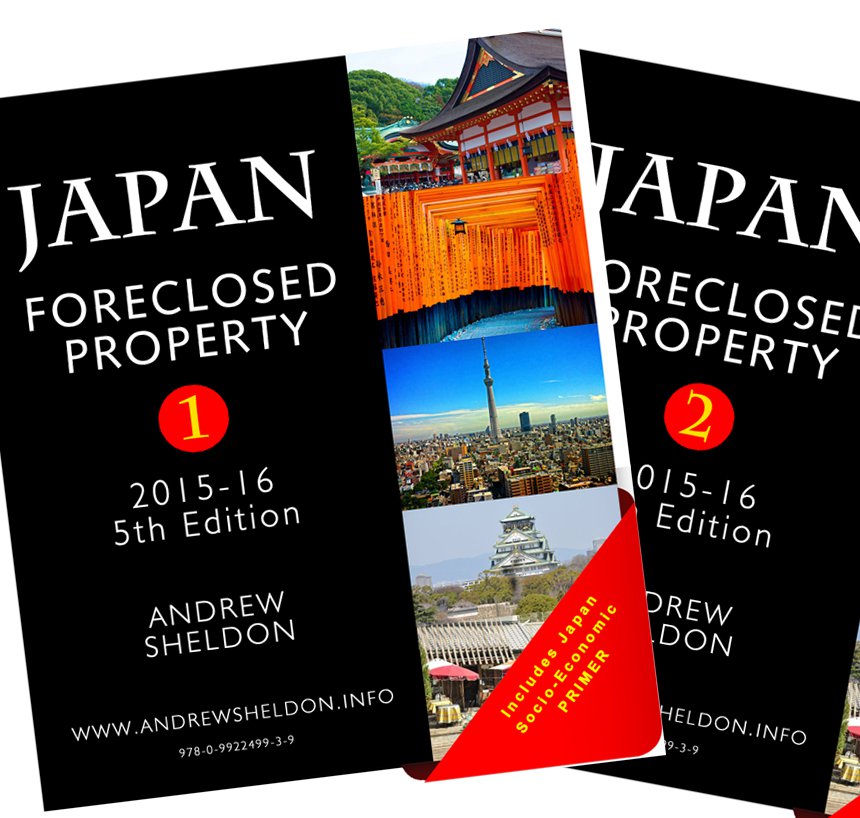
Japan Foreclosed Property 2015-2016 - Buy this 5th edition report!

Over the years, this ebook has been enhanced with additional research to offer a comprehensive appraisal of the Japanese foreclosed property market, as well as offering economic and industry analysis. The author travels to Japan regularly to keep abreast of the local market conditions, and has purchased several foreclosed properties, as well as bidding on others. Japan is one of the few markets offering high-yielding property investment opportunities. Contrary to the 'rural depopulation' scepticism, the urban centres are growing, and they have always been a magnet for expatriates in Asia. Japan is a place where expats, investors (big or small) can make highly profitable real estate investments. Japan is a large market, with a plethora of cheap properties up for tender by the courts. Few other Western nations offer such cheap property so close to major infrastructure. Japan is unique in this respect, and it offers such a different life experience, which also makes it special. There is a plethora of property is depopulating rural areas, however there are fortnightly tenders offering plenty of property in Japan's cities as well. I bought a dormitory 1hr from Tokyo for just $US30,000.
You can view foreclosed properties listed for as little as $US10,000 in Japan thanks to depopulation and a culture that is geared towards working for the state. I bought foreclosed properties in Japan and now I reveal all in our expanded 350+page report. The information you need to know, strategies to apply, where to get help, and the tools to use. We even help you avoid the tsunami and nuclear risks since I was a geologist/mining finance analyst in a past life. Check out the "feedback" in our blog for stories of success by customers of our previous reports.

Download Table of Contents here.